Kennst du den Schwan?

Fragments on Wagner’s LOHENGRIN.

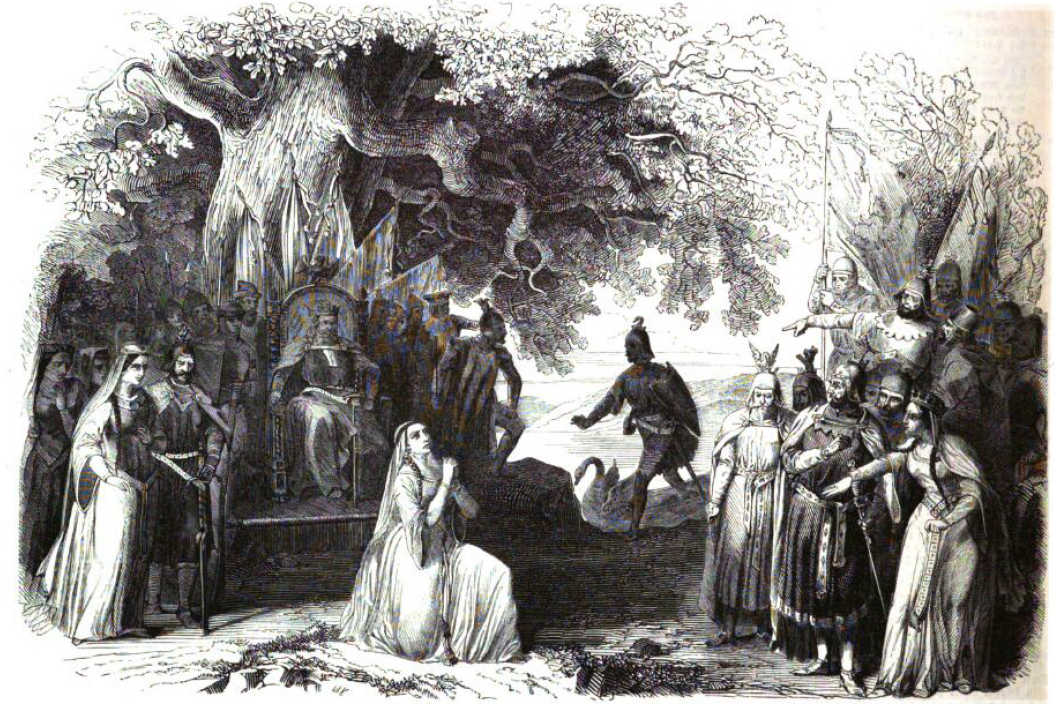
Wagner’s silvery-blue “romantic opera” Lohengrin premiered at the Großherzogliches Hof-Theater in Weimar on this date in 1850.[1] Perennially popular in the succeeding century and a half, its tale of the “nameless” hero born onstage by a swan has been experienced in over two dozen productions around the world over the last two years alone. The production at the Bayreuth Festival this summer had its own knightly rescue twice-over with Yuval Sharon—the first American stage director in the festival’s history—taking over from Alvis Hermanis, and Piotr Beczała stepping in for Roberto Alagna. Lohengrin has had a generous share of rescuers throughout history, reaching back to that first performance in Weimar under Franz Liszt.


Origins of the Work

Familiar with figure of Lohengrin from at least 1841, Wagner made his first dramatic sketches for the work during a fruitful sojourn in Marienbad in 1845 for his health. (That same summer also spawned the first notions of Die Meistersinger, and Parzival was on his reading list as well.) The full score was completed on April 28, 1848, with a new transitional passage for act 3 later interpolated in 1851. The premiere was announced for 1849 in Dresden, where Wagner was then Kapellmeister of the Saxon Court. New sets were contracted, but Wagner’s participation in Dresden’s May Uprising of that year and his eventual exile in Switzerland brought those plans to naught. (Such political theatrics were apropos given that assemblies and armies are part and parcel of the dramaturgy of Lohengrin, a particular challenge for productions in the postwar era.) While the end of act 1 had been premiered in 1848 during a concert marking three hundred years of the Weimar Hofkapelle, the rest of the opera was doomed to remain unheard.


Enter Franz Liszt

Or rather enter Wagner’s entreaties to the Kapellmeister extraordinaire in Weimar. Wagner kept up an avid correspondence to convince Liszt to produce the work, a formidable challenge for such a small court theatre operation. (Weimar had, however, mounted Wagner’s Tannhäuser in May of 1849, a work of somewhat comparable spectacle.) Liszt did yeoman’s work to clear the air in the court of the whiff of Wagner’s politics, a telling effort for the work’s legacy. There were other cultural concerns to navigate. The gala performance coincided with the one hundred and first birthday of Goethe and the dedication of the Weimar memorial to Herder. The scheduling was a bold choice on Liszt’s part, but also an understandable step in his attempt to connect the “golden age” of Weimar with his own endeavors to modernize the court theatre repertory.
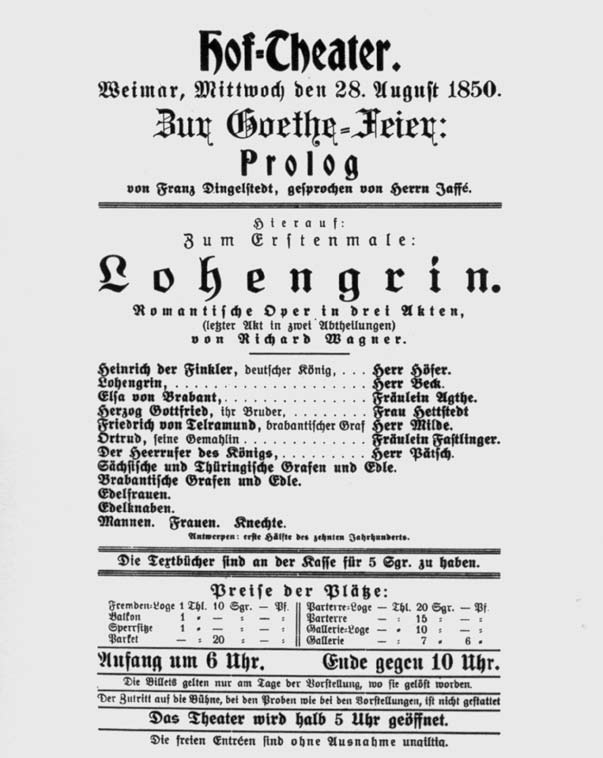
bill

Some 2000 thalers and forty rehearsals later, Lohengrin bowed before its first audience, prefaced by a commemorative prologue from author-actor Franz von Dingelstedt. (It is a strange mélange of patriotism and mythology.) Wagner heard much about the performance, including the exasperating fact that it timed out at 75 minutes (!) beyond his own estimation of its length. He was particularly concerned with the declamation of the singers, especially since Lohengrin marked a considerable step forward in Wagnerian expression. The composer sent considerable notes concerning the design and staging of the work, which he later published. He himself would not see the work performed until he attended a rehearsal in Vienna in 1861.


Swan Fans

The legend of the Knight of the Swan boasts many an assiduous fan, to say the least. (Who wouldn’t want a prince coming to your rescue?) After attending a performance in 1861, the legend and the knight remained one of the stronger obsessions of King Ludwig II of Bavaria. Swan imagery is abundant in his structures, Neuschwanstein perhaps eclipsing all others. It is important to note that Ludwig’s conception of “Romanticism”—if it can even be called that—was more eclectic than the trope of the Märchenkönig would imply. He had an unshakable devotion to the legacy of Louis XIV and the Rococo (as evinced in Herrenchiemsee and Linderhof), as well as fashionable attitudes towards rusticism and Orientalism common to his era. Ludwig’s aesthetics also embraced a strongly historicist attitude, something that often exacerbated Wagner where set and costume designs were concerned, particularly with his opera. Thomas Mann was also a concerted devotee, his memories of first hearing the prelude among the most lingering in his memory.


Moment of Note

Apart from testing how long it takes for one character to cross the stage, Lohengrin boasts one of the most accomplished and sublime preludes Wagner ever wrote. A masterpiece of orchestration and structure, his program note from Zurich in 1853 describes how the piece depicts the delivery of the Holy Grail to earth by the heavenly host. At its climax, “the observer’s senses diminish; he sinks down in devout annihilation.” Can’t put it better than that.


[1] Pace the abuse of the term “music drama” with Wagner’s stage works, both the placard for the premiere and the text published in Weimar give the subtitle as “Romantische Oper in drei Akten.”

“I swore to love him” or, On-again/Off-agains with “Der Rosenkavalier”

FullSizeRender-2Anniversary meditations on the works of Richard Strauss.

As breaks amid preparations for my exams, I’m revisiting Strauss’s major works on the anniversaries of their premieres with more informal and personal, if not occasionally wandering, musings.

Today, a big one:

Der Rosenkavalier

Premiere: Königliches Opernhaus, Dresden; Thursday, January 26, 1911

The calendar struck with two big Strauss anniversaries back-to-back, so this offering is unfortunately tardy. Looking over the fare I offered on Elektra and Metamorphosen, I realized that I skirted too closely around the shoals of formality. The benefit of a medium like this is frankness. One should always be accurate, of course, and I welcome any and all responses to what I’ve written. My goal is to nourish kernels of my own thoughts which would not likely have a friendly home in a more academic venue, and wrestle with ideas without concern if they come up short. Much will end up ultimately being fragments, a form too often undervalued.

Which brings me to the work under consideration for today, perhaps the most quintessential of all Strauss stage works: Der Rosenkavalier. Lately, I’ve been perplexed. When it comes up in discussion, I routinely stifle a sensation close to ambivalence. Moods happen—yet this tepidity is different. It’s not a case of out-and-out dislike. As someone who studies opera production history, Rosenkavalier is one of the central case studies, and for good reason. Apart from the joy that is the work of designer Alfred Roller, the circumstances of the premiere (Strauss’s contractual battles, wounded feelings at Dresden, Max Reinhardt’s involvement), no matter how many times retold, still yield forth fresh gems. Beyond this, Der Rosenkavalier is central to the Strauss canon, the wider operatic repertoire, and the course of art music in the twentieth century. Yet in putting these thoughts down, I find the same sensation surfacing again. Whence this dissatisfaction?

In this regard, I am not alone. Though this was the first original collaboration of Strauss and Hofmannsthal (Elektra already existing as a stage text) and easily their most successful (at least commercially), at certain points they themselves perceived personal qualms. Strauss later admitted the work was hampered by longeurs of his own making. More bitingly, before the ink on the score was dry, Hofmannsthal was venting his distaste of Strauss’s efforts to Count Harry Kessler with one hand while dashing off praise to the composer with the other. Despite these misgivings, no attempt was made to revise the work as with Ariadne auf Naxos, though Strauss did eventually sanction cuts. (Myself, I prefer the work without them.) One could look to Arabella, so often described (both positively and negatively) as a “second Rosenkavalier,” as an attempt to respond to the earlier work, but such a tack soon runs into a slough of its own.

It may be, simply, just Rosenkavalier fatigue on my part. Some of this fatigue, however, is relief. The hackneyed critical line about Rosenkavalier as a threshold of regression has been soundly obliterated, though it occasionally resurrects itself. Furthermore, the work has been the center of valuable attention in the last decade. Michael Reynolds has offered a probing study of the contributions of Count Harry Kessler and the origins of the scenario in the 1907 operetta L’Ingenu libertin. The press response to Glyndebourne’s production in 2014 exposed and incited a valuable dialogue about body-shaming in opera criticism. There also was a recent Opinion piece for the New York Times online, which I shall address at a later date. These latter two instances point to the greatest challenge facing the work, indeed the entirety of Strauss’s output: how do (and how will) these works speak—through performance—to the concerns of our century? What answers can a “comedy” so inexorably and problematically tied up with questions of gender and power provide to #metoo? Opera’s not-impalpable undercurrent of misogyny has drawn our comfort with numerous works of the nineteenth century into question, along with how they appear in the hands of contemporary directors, designers, and performers. The rest of the repertory faces similar scrutiny.

These criticisms are in no way new; indeed, they are if anything long overdue for response, as well as action. Ultimately, criticism and exegesis on the web or on paper only reach so far. These are dramatic works and answers to their questions are (and must) be found in performance. It may be that once Strauss’s works fall completely into the public domain across the globe, much will be done in the way of reinvention, reinterpretation, and recasting, both literal and figurative. This is a sensitive nerve with Rosenkavalier, since its stage history is so inexorably bound with attempts to preserve a particular vision of the work—as the creators “intended” it to be. I am tempted to say that “traditional” Rosenkavaliers will always be with us, but really, what does “traditional” mean, and what is a “traditional” Rosenkavalier? Is it merely rigid adherence to the original designs and prompt book? The complete score with the complete forces dictated by the composer? Or is it more a vision of what will placate opera’s Achilles heel: the ever-feared but always necessary audience that may provide that fatal rejection of not buying tickets or donating money if what they see fails to entertain or holds up too brutal a mirror.

I frequently quip, with much seriousness, that someday someone will produce a version of the Ring with a dozen performers, two pianos, two chairs, and a stick, and it will be the greatest revelation in Wagnerian history. Strauss could do with the same. If the works are strong enough, rich enough, and powerful enough, they will survive being adapted, being challenged, being put into dialogue with what was once done, and what could be done the next time around. We may wring hands that the creator’s wishes are being violated, disgraced, or some other melodramatic participle. No doubt, Strauss and his librettists would have strong and resolute opinions on what they would see on the stages of today’s opera houses, but these acts of supposition are just that. I don’t mean to give carte blanche to interpretations that take little of the dramatic and musical substances of the work into account. The informed is always the enemy of the reckless. And we must hold the unaccounted for accountable in what we see onstage. If, like the Marschallin, we have sworn to love these works to the point that we can appreciate attractions to them from other corners, then we too can support a plurality of approaches to them.

A Coda. We must not forget that Strauss took his own “liberties” in bringing Gluck (Iphigenie auf Tauris), Beethoven (Die Ruinen von Athen), and Mozart (Idomeneo) to the stage in his own era. January 26 also marks the anniversary of the premiere of Mozart’s Così fan tutte, a clear ancestor of Rosenkavalier and one of Strauss’s specialties as a conductor. It is also the eve of Mozart’s birthday. Strauss’s reverence for the composer was nigh on absolute, but even he abjured pedantic adherence to tradition. I’m reminded too of Strauss’s epithet “the divine Mozart,” and how, in a late philosophical fragment on his forebear, Strauss considered his melodies to be “primal types” (Urbilder) to be experienced by emotion, breathed in by the ear. If Strauss could still breathe a different sense into Mozart a century and a half after his death, we should be able to do the same for Strauss in our own century.

(c) Ryan M. Prendergast, 27 January 2018.