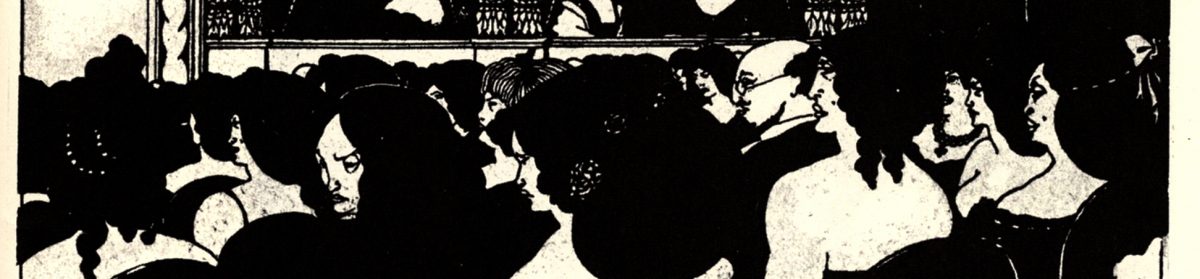

Farrago for March 29–April 4

Ka-booms, whipped cream, and a double serving of Sondheim.

farrago, n. — A confused group; a medley, mixture, hotchpotch.


MARCH 29

1918: Pearl Mae Bailey is born in Newport News, Virginia. One of the greatest singers and entertainers of the twentieth century, she conquered vaudeville, Broadway, and television. Her film performances, sadly, were too few and far between, but younger generations will always recognize her as the voice of the owl Big Mama in Disney’s The Fox and the Hound. Her Dolly Levi remains, however, the stuff of legend, partially immortalized on a surviving broadcast of The Ed Sullivan Show, including the famous monologue preceding “Before the Parade Passes By.”

***

“Where’s the kaboom? There was supposed to be an earth-shattering kaboom!”

1958: Hare-Way to the Stars debuts. The first Marvin the Martian short in five years after Duck Dodgers in the 24½th Century, Hare-Way marked Bugs Bunny’s third run-in with the immortal “character wearing the spittoon.” This is by far the most visually stunning of the MtM shorts under director Chuck Jones, thanks to Maurice Noble’s stellar production design of futuristic terraces and elevators sprawling out amid some breathable pocket of space. One of the highlights is Bugs’s lazzi with the buzzardly “Instant Martians” on the rocket scooters.

MARCH 30

1746: Francisco José de Goya y Lucientes is born in Fuendetodos, Spain. Whether mammoth canvas or macabre etching, Goya fused the masterly traditions of Europe’s artistic past with an ironic modernity reflecting his own present.

“Escena de Inquisición,” (1808-1812). Oil on panel. Real Academia de Bellas Artes de San Fernando.

***

1913: Animator and Disney Legend Marc Davis is born in Bakersfield, California. One of the famous Nine Old Men of Disney Animation, Davis worked on most of the studio’s classic features until the 1960s, when he turned his hand to the design and development of the company’s amusement park attractions. Davis was tasked with animating many of the great female characters in the studio’s canon, none greater than Sleeping Beauty‘s Maleficent (voiced by Eleanor Audley) and Cruella De Vil from One Hundred and One Dalmatians (voiced by Betty Lou Gerson). The all-to-rare Disney Family Album series did a great episode on Davis with extended interview clips.

MARCH 31

“All that is real and can be sensed is in constant contact with magic and mystery; one loses the consciousness of reality.”

1872: That prince of impresarios, that scion of sybarites, Sergei Pavlovich Diaghilev is born in Selishchi.

May be an image of 1 person
Serov’s 1904 portrait of Diaghilev.

***

1913: A mostly unsuspecting audience gathered in the Golden Hall of Vienna’s Musikverein for a performance by the Wiener Konzertverein conducted by Arnold Schoenberg. Turmoil eventually broke out and the concert never finished.

On the Programme:
Anton Webern: Six Pieces for Orchestra, op. 6
Alexander von Zemlinsky: Four Songs after Poems by Maeterlinck (eventually Nos. 1, 2, 3, and 5 in op. 13)
Arnold Schoenberg: Chamber Symphony No. 1, op. 9
Alban Berg: Orchesterlieder, nach Ansichtkarten-Texten von Peter Altenberg, op. 4, nos. 2 and 3
Gustav Mahler: Kindertotenlieder

The performance disbanded before the Mahler, which meant that only 13 pieces were performed, always a fun number for the triskaidekaphobic Schoenberg.

***

1935: Herb Alpert is born in Boyle Heights, Los Angeles. Whipped cream for all.

APRIL 1

1919: The traditional anniversary of the founding of the Staatliches Bauhaus in Weimar in 1919, under the direction of Walter Gropius, here (center) with other instructors from the later school in Dessau. His manifesto for the group from that year reads thus: “So let us therefore create a new guild of craftsmen, free of the divisive class pretensions that endeavored to raise a prideful barrier between craftsmen and artists! Let us strive for, conceive and create the new building of the future that will unite every discipline, architecture and sculpture and painting, and which will one day rise heavenwards from the million hands of craftsmen as a clear symbol of a new belief to come.”

May be an image of 12 people and people smiling

***

1932: Debbie Reynolds is born in El Paso, Texas. The last of the great broads of entertainment, Reynolds kept up a remarkable career until her final years.

APRIL 2

1891: Artist Max Ernst is born in Brühl, Germany.

***

1939: Marvin Gaye is born in Washington, D. C.

APRIL 3

Edward Carson: “The majority of persons would come under your definition of Philistines and illiterates?”
Oscar Wilde: “I have found wonderful exceptions.”

1895: Thanks to a badly-spelled calling card inscription from the Marquess of Queensbury and an aesthete’s hubris, the libel trial of Wilde v. Queensbury began on this date in 1895 at the Old Bailey. The Marquess was eventually acquitted and Wilde was left bankrupt with two further trials, incarceration, disgrace, and ruin ahead of him. Wilde’s predilections for the young poor force a difficult reckoning in our own era, where he is held up as an author as well as a martyr for gay rights. If tried today, he likely would be labeled as a sex offender.

May be an image of 1 person
Cartoon from the Police News, May 4, 1895.

***

1968: Stanley Kubrick and Arthur C. Clarke’s 2001: A Space Odyssey goes into general release. It is still one of the guiding pillars of cinematic science fiction, with a tactility, believability, and mystery which has yet to be surpassed, along with the benefit of one of cinema’s most insidious villains (“Dave, my mind is going.”). It is also a musical smorgasbord, with (not uncontroversial) slices of Henry Dacre (“Daisy Bell”), more Ligeti than you’ll ever hear in most concert halls, Johann Strauss II, and, of course, Richard Strauss. I suppose there’s something to be read into Kubrick’s choice of Karajan’s recording of Also sprach Zarathustra from Decca, which the company’s management considered a sales liability and initially suppressed the connection. Much like Strauss’s tone poem, the philosophical currents of the film are, properly speaking, “freely after” Nietzsche (and a number of others). Though the notion of the “eternal recurrence” remains perhaps its deepest connection with the motif of the monolith, there’s a certain wicked resonance with the emphasis on weightlessness, the final tableau of the Star Child in orbit, and Nietzsche’s exhortation to kill the spirit of gravity.

APRIL 4

1906: Bea Benaderet is born in New York City. A presence on countless radio and television shows, she is probably known as the original voice of Betty Rubble for Hanna-Barbera, as well as countless other characters in the Warner Bros. animated shorts of the 40s and 50s. Along with the annoying bobbysoxer Red Riding Hood (“HEY, uh, GRANDMA! That’s an awfully big nose for you… TO HAVE.”), this moment may be her finest: “Goodness! Can’t a body get her shawl tied? Heavens to Betsy!”

***

“Crazy business this, this life we live in.”

1964: Sondheim’s Anyone Can Whistle opens at the Majestic Theatre on Broadway. An absurdist outing with Arthur Laurents, it only lasted for 9 performances before closing. Whatever the reservations about the book, it is a genius score, with more pearls than most could hope for in a lifetime. The original cast album, recorded after the show closed, is a marvelous artifact of Angela Lansbury’s first musical and, hey, Lee Remick should’ve done a few more.

***

“Nature never fashioned a flower so fair.”

1971: Sondheim and James Goldman’s Follies opens at the Winter Garden Theatre. A gorgeous and bittersweet love letter to so much that’s temporal, it is one of the few musical works that remains genuinely haunting, like a vision in vapors. Probably best they didn’t stick with the plan to have it be a murder mystery.

Until next week!
How you were, how you are: Thoughts on the new Munich Rosenkavalier

Elegance is often confused with opulence, and possibly no opera has suffered from this misconception more than Strauss and Hofmannsthal’s Der Rosenkavalier. The concocted atmosphere of the “old Vienna” of Maria Theresa in this “comedy for music” rightly conjures up delightful visions of period-piece-delight, but between idea and the stage reality, to paraphrase T. S. Eliot, lies a great shadow, often one of vacuous kitsch. (A comparable situation exists for Broadway’s golden age blockbuster My Fair Lady, which, in its film incarnation and later stage life, became an orgy of grandiose sets and extravagant Edwardian couture to the detriment of the story.) One can sense the roots of the issue already in Alfred Roller’s celebrated designs for the 1911 Dresden world premiere, which achieved the delicate balance between these two poles with their deceptively restrained spaces, even in the crowded tavern room in act 3. Subsequent derivations from the Roller models, however, acquired more literal and figurative mass. The designer himself indirectly contributed to the trend by altering the design for act 2 in 1929 for conductor Clemens Krauss and director Lothar Wallerstein. The Saal in Faninal’s city palace was opened up with inlaid glass windows and doors to reveal a sweeping staircase beyond.

The famous contractual obligation for Roller’s designs did much to stabilize Der Rosenkavalier as an recognizable artistic product, but often at the expense of the original’s freshness. Munich Strauss doyen Rudolf Hartmann later lamented how an obligatory respect for Roller’s designs endured even as more independent and imaginative solutions for staging the opera began to appear. Ironically, Hartmann himself helped to crystalize (or, as more cynical commentators might say, calcify) the tradition in 1960, with the staging of a mammoth new production to inaugurate the newly finished Grosses Festspielhaus at the Salzburg Festival with designs by Teo Otto. Similar Rococo grandeur reached North America in 1969 with the debut of Nathaniel Merrill and Robert O’Hearn’s lavish production for the new Metropolitan Opera House at Lincoln Center, after a five-year absence from the company’s roster. It lasted in the repertory until 2013, after which it was replaced by Robert Carsen’s new staging in 2017, which embraced the period of the work’s composition, showing a pre-World War One Vienna at the height of decadence. In Munich, the announcement that the renowned and well-toured Otto Schenk/Jürgen Rose production at the Bayerische Staatsoper, first introduced in 1972, would be replaced prompted a “rescue” petition to the office of the intendant Nikolaus Bachler.

Despite such protestations, the fêted staging was finally superseded at the Staatsoper this past weekend, with a new production conducted by the house’s music director designate Vladimir Jurowski and staged by Barrie Kosky, the intendant of the Komische Oper Berlin. (The livestream is available on Arte.tv until April 19 here.) Taking a unique route between opulence and elegance, Kosky’s Der Rosenkavalier reimagines a repertory warhorse in Munich with evocative ideas. While some elements of the concept play out less successfully than others, it nevertheless achieves a unique piquancy, smiling through one eye and crying through the other.

One must first commend Jurowski’s handling of the Staatsoper orchestra in a reduced configuration necessitated by pandemic restrictions. While reduced orchestrations for Salome and Elektra were licensed through his publisher Fürstner, Strauss never sanctioned such an edition for Rosenkavalier in his lifetime. Thankfully, Eberhard Kloke’s 2019 arrangement of the score, published by Boosey and Hawkes and utilized by the Staatsoper, succeeds in its own reimagining of Strauss’s original orchestration of 100+ players down to the scale of the instrumentation used in Ariadne auf Naxos, a minimum of 43 players, maximum 50. One senses here, however, a wise move on the part of Boosey & Hawkes to keep some vestige of control and profit from the Strauss catalog after the expiration of its copyrights in 2020. Kloke also has arrangements of Salome and Elektra for reduced orchestras as well. The similarities of the Kloke Rosenkavalier arrangement to Ariadne are especially pronounced in the addition of piano and harmonium, imparting a chamber feel throughout to what has arguably always been a Mozart opera flirting with Wagnerian dress. The effect in no way diminishes the score, which still packs its wallop while never overpowering the singers, a lifelong bugbear for Strauss himself.

In Kosky’s dramaturgy, with scenic design by regular collaborator Rufus Didwiszus and costumes by Victoria Behr, the crucial motif of time dominates the stage. Time, its passage, and human reactions/resignations to it are, of course, famous elements of the Marschallin’s character, as expressed in her monologues in act 1. The primary dramatic symbols of time onstage are a series of extra-musical chiming clocks that open each act before the respective prelude. For the first, a large grandfather’s clock strikes 6 o’clock (the same hour as the Dresden premiere on Thursday, January 26, 1911) before spinning in a clockwise frenzy the mimics the music’s infamous depiction of raucous sexual congress. For act 2, a more utilitarian alarm clock mounted on the prompter’s box awakes Sophie at 8 o’clock for her fateful ceremony with Octavian and Baron Ochs. For act 3, a more whimsical cuckoo clock heralds midnight and the start of the nocturnal farce that humiliates Baron Ochs and unites Octavian and Sophie. It is the act 1 clock, however, that recurs throughout the staging. Following the prelude, the Marschallin and Octavian emerge from the case through pendulum door in a state of afterglow. The gesture is effectively inverted in the final moments of the act, when the Marschallin, left alone by Octavian to make her way towards mass, climbs inside the clock case from the rear and pensively sits on the pendulum as it swings back and forth.

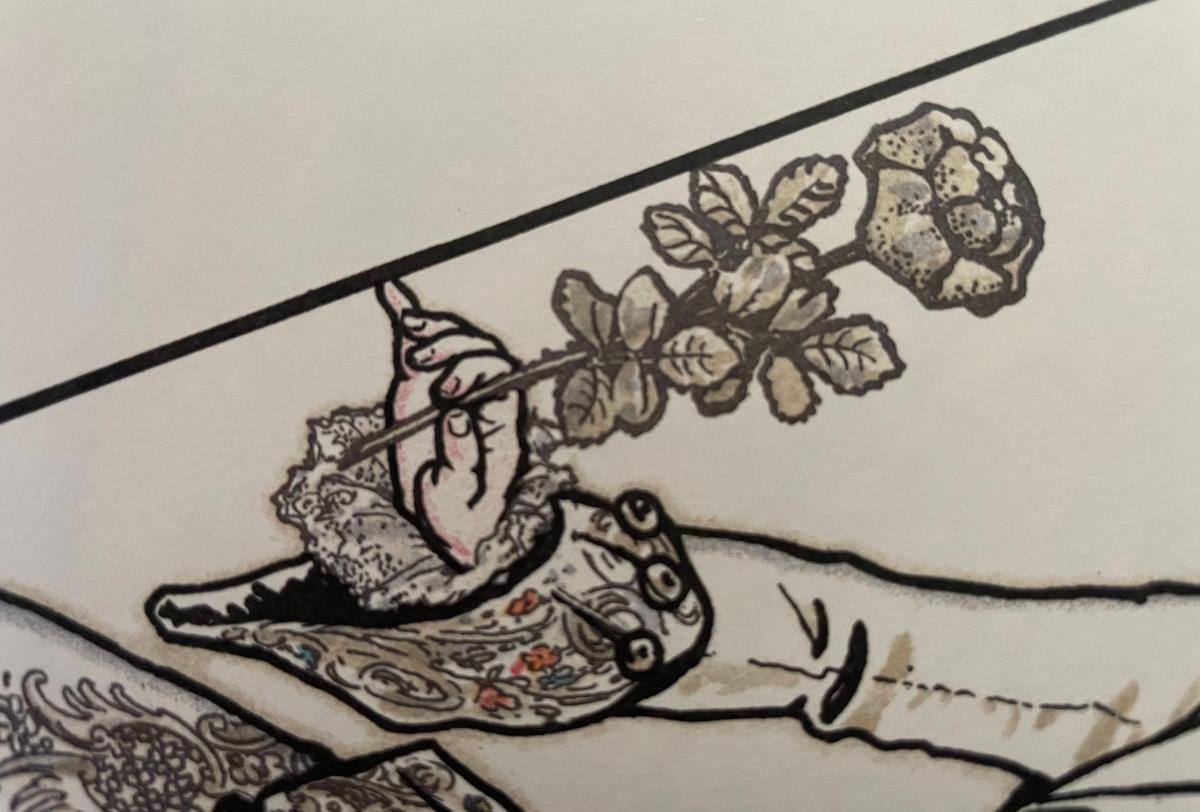
The prop clock returns at the end of the opera, in conjunction with the production’s other reigning dramaturgical device, that of love in the allegorical embodiment of Cupid. The stage is not menaced by a mischievous putto, but rather a comically-antiquated winged sprite more akin to Father Time, played by Ingmar Thilo. He first appears during the Frühstuck section of act 1, which here is staged as a playful chase between the Marschallin and Octavian amid sliver topiary. As they kiss, Cupid flings a handful of silver sequin confetti into the air. He returns to observe, participate in, and trigger the stage action. Notably, Cupid plays the panpipe to summon the Marschallin’s memories of the Italian Singer, drives Octavian’s silver carriage in act 2 for the Presentation of the Rose, flings his sequins over Octavian and Sophie during their first kiss, and witnesses the final bedroom farce, staged on a miniature theater stage oriented in reverse with a nondescript auditorium upstage. In the final moments, Cupid returns seated atop the grandfather clock. He watches over the duet of Octavian and Sophie and the Marschallin’s poignant “Ja, ja” of renunciation. As lingers in front of the clock case, Octavian and Sophie reenter for their final strophe, now taking literal flight with the silver rose. Left alone after the others exit, Cupid leans over the clock face, opens the glass, and removes the minute hand, leaving the hour hand at 6. He impishly holds it aloft as the clock sinks below the stage. (The bit replaces the page Mohammad’s whimsical search for Sophie’s handkerchief in the original scenario.) Like the Marschallin in the middle of the night, it seems that love can temporarily stop time, at least as long as it wants. While the initial Cupid appearance seems heavy-handed—here is love doing want it will do—there is a “nudge-nudge” quality to the entire interpolation that grows in strength over the course of the production.

Eschewing the familiar Rosenkavalier-realism, Didwiszus’s designs pursue three distinct worlds following the production’s conception of each act as an opera in and of itself based on the dominating characters: the Marschallin, Sophie, and Octavian. (A helpful discussion of this appears in the Online-Matinee for the production.) The world of the Marschallin in act 1 takes place in shadowy chambers etched in silver, aided by Alessandro Carletti’s lighting design. Gone is the infamous bed that incensed many in 1911. Instead, anchored by an upstage wall evoking an eighteenth-century palatial salon, a kaleidoscopic sequence of spaces, defined by wall units and other properties, moves across the stage throughout the act. Unfortunately, these constant shifts occasionally upstage the action in what is an extended dialogue between the Marschallin and Ochs, though some of the tableau, such as a series of Cupid statuettes, provide for effective staging bits. The often hackneyed leveé scene takes on a new level of chaos, with characters rushing in and out of the Marschallin’s mental and emotional space. Various gestures towards earlier historical periods are also introduced amid the transitions. The aria of the Italian Singer is staged as a wistful Baroque opera flashback with costumes recalling Ernst Stern’s designs for the world premiere of Ariadne auf Naxos in 1912. (Hofmannsthal adapted the text of the Singer’s aria from Le bourgeois gentilhomme, which later became the Ariadne framing device.)

Act 2 is conceived as an elaborate gallery of paintings, a fantasy world for the virginal Sophie, complete with her brass bed and scrapbook of Octavian clippings. Kosky stages the Presentation of the Rose as the entrance of the Knight of the Rose’s elaborate silver carriage, alluding to the golden coaches of Bavaria’s Wittelsbach dynasty. More extreme is the theater configuration for the final act, which adds a metatheatrical layer to what is already elaborate “performance” to ape Ochs. Some components of the original scenario are translated with lessened effect in such a setting. Hofmannsthal’s device of the pranksters laying in wait is reinterpreted somewhat awkwardly as agents of Valzacchi and Annina dressed as doubles of Ochs. Others, however, deliver stronger results. The curtain for the mock theater is drawn during the buffoonery, hiding the upstage auditorium space from view, but at the proper moment, the panels part to reveal the black-attired Marschallin as a lone observer in the theater seats and Cupid now serving as prompter.

Marlis Petersen, once a Sophie in the previous Schenk Rosenkavalier, makes her role debut as the Marschallin with this production. Fitting her extraordinary dramatic gifts, she imbues the role with, to borrow from Roland Barthes in another context, a bittersweet punctum that vividly renders innumerable nuances of both text and music. Samantha Hankey gives a vigorous edge to Octavian while registering the character’s latent self-awareness of his impetuosity. This plays out poignantly in act 3 when Octavian realizes his relationship with the Marschallin is over. Katharina Konradi’s Sophie was something of a revelation dramatically. Like Asmik Grigorian’s Chrysothemis in Salzburg last summer, Konradi flipped a habitual swooning ingenue role into one of agency and perspicacity. More ambivalent is Christof Fischesser’s interpretation of Ochs. While exhibiting a clear command of comedic skill, particularly in the Mariandel scenes of act 1 and the duel in act 2, which is staged as a minuscule finger prick, Fischesser’s Ochs lacks something of the brusqueness that makes the character both endearing and repulsive. Strauss once described the Baron as, fittingly, Don Juan “translated into the comic,” so an impulse akin to forwardness is necessary. Johannes Martin Kränzle did yeoman’s work as a delightfully avuncular Faninal, and the remainder of the supporting roles were well filled out.

Plaudits are due to the Staatsoper for producing one of the largest operas in the repertoire in the era of social distancing without a hint of diminishment. One looks forward to seeing how the production evolves in a post-Covid landscape.