Dissertations: I. The Path to the Project

Back from the Land of Dissertations with thoughts on it all.

On Friday, February 26, I successfully defended my dissertation “The Theatrical Collaborators of Richard Strauss: Networks, Materials, and Cultural Politics.” As I am long overdue to resume blogging, this post is the first in a series about my research, as well as the process of completing a dissertation during the era of COVID-19. As always on this blog, I embrace the format of the fragment, which is also the prevailing mentality after so much work. I state at the outset that I only write to and from my own experiences.

***

Having reached my destination, it is only natural to reflect and wonder how it all (miraculously) came about and came together. For me, this is mostly an act of endless cringing, as I am always inclined to see most successes as “almost-were-failures” saved by pluck and luck. Perhaps, once upon a time, I read too much into an anecdote that stuck. The Roman generals awarded triumphs were accompanied in their processional chariots by slaves who warded off the “evil eye” by whispering into their masters’ ears: “Look behind you, and remember that you are a mortal.” Success is never a sure thing, and (chalk it up to a Catholic upbringing) relishing in it is dangerous. I would do well, however, to remember the Stoic Epictetus’s related observation: “Whenever you grow attached to something, do not act as though it were one of those things that cannot be taken away, but as though it were something like a jar or a crystal goblet, so that when it breaks you will remember what it was like, and not be troubled.”[1]

***

I vividly remember in my final year of undergrad informing a professor who asked that I had no interest whatsoever in getting a Ph.D. Now it seems to be the most obvious course, but back then, I would have none of it. The path of the ensuing decade led to work as a professional stage manager, opera house intern, professional theater apprentice, a marketing and events assistant, more odd jobs than I care to count or remember, plus one year of a stage management M.F.A. program, then jump into a musicology master’s, one year of a musicology Ph.D., five cross country moves, one international move, and a pandemic. Fortunately, I can say that all of it was valuable. Finally, none of it would have been possible without my husband Robert’s love and support, the constant through it all.

***

Blame opera. The nerdish hobby became the scholastic occupation. It was not, however, clear that it would be Strauss. I went into my master’s wanting to go after Wagner, but 2013/2014 was Wagner hot for the anniversary year. Strauss, however, stood me well in two first semester musicology seminars, and there was plenty to keep me going. Robert Graves once commented on the success of his I, Clavdivs books that since he was good to Claudius, Claudius was good to him. I would like to feel that Strauss and I operate the same way.

***

Ten Observations for Dissertators:  

  1. You, your research, and your writing are all worth it, and never concede that to anyone. My academic path was blessed (the only time I will ever use this adjective without irony) with so many encouraging figures. It also had its share of antagonistic malefactors, who are better left nameless and forgotten. Sadly, hazing in all branches of the academy can at times border on psychological warfare. While some can claim this is done in the service of higher goals and betterment, I politely deem that line of thinking to be patent tripe. You cultivate gardens. You do not steamroll them. The roster of adversaries also includes people outside the academy who think that writing carries none of the worth or strain of conventional labor. I encourage you to ask them to write over 200 pages sometime.
  2. Belief in worth does not preclude self-criticism and your own sense of (hopefully rigorous) standards. You owe it to yourself and your subject to make your thinking and writing as robust as possible. Nothing is less enjoyable to read than something written in a mediocre or slapdash manner unless that be your intention. Grasp what is effective and keep asking yourself to be better. Commit to improvement in all its facets as much as it is possible.
  3. You are nothing without the help of the staffs of your department and university library. These people are the ones who get so many thankless tasks done. Value and praise them.
  4. Write the kind of scholarly writing that pleases you. Myself, I like accessible writing that tells a good story with lots of concrete and cited evidence without getting bogged down in jargon or dubious theoretical constructs. The voice I always have in my head is that of Frederic Spotts in his history of the Bayreuth Festival, which I highly recommend everyone read. It is valuable to general readers and experts alike.
  5. Find writing methods and habits that give you the time and headspace to work effectively. This is often the most formidable task for graduate students whose time, even before they move into the full dissertation phase, is substantially occupied by their own course work, whatever job(s)/appointment(s)/funding they have to see them through, to say nothing of their own private lives. (I used the term “work” above since dissertating involves not only writing but reading, searching, thinking, among other tasks.) Early on, I found it helpful to identify how long a reasonable period of work can last and where it fell in the day or week. I am generally best with three-hour blocks early in the morning, but on days when I am on my own, I could squeeze in up to three of these blocks in a day. Coupled with this is the need to identify when you reach the point of diminishing returns. Your mind, as well as your body, will let you know when to call it a day. For me, this happens in the evenings when I feel my nose go cold after hours staring at a computer screen.
  6. But still, write something every day. I admire the goal Shirley Jackson set for herself to write one thousand words a day and am thankful on the odd days when that actually happens. I am also grateful for days when I can only get down a few sentences. At least they are a few sentences more than the day before and a day without sentences. Like stretches, writing only gains efficacy when it is done regularly.
  7. Write what is in your mind to get it out of your mind. One of the biggest lessons I learned was the value of being flexible about what I was putting to paper. Just because I was writing on one topic in a chapter did not mean I had to stick at it to the exclusion of everything else.
  8. Plans are there to be changed. This applies from everything to internal chapter outlines to the entire scope of the dissertation. While matching the result with the initial idea would be a pleasure in itself, genuine discoveries—the greatest of academic pleasures to my thinking—are genuine blessings.
  9. Assemble reliable playlists, especially for challenging moments. My go-to’s for when I need to stay focused are Russian symphonies, Shostakovich’s Eighth and Twelfth, and Prokofiev’s Fourth (the revised version) at the top of the list. Though I authored a dissertation about Strauss, I (un)surprisingly listened to Strauss’s music sparingly while writing, at least not the operas. Since I tend to get caught up in the dramatic action, I avoid working with texted music in the background (For Strauss, this meant relying on the tone poems, generally Kempe’s recordings with the Dresden Staatskapelle). There were, however, some significant exceptions to this rule. About mid-autumn of 2020, with inspiration flagging, I found bizarre solace in Apple Music’s 90s Soft Rock playlist, mostly because these were songs I heard on the radio growing up, and they helped put me in a more childlike (read: open and playful) state of mind. And because sometimes you just need undemanding music for its beat, RuPaul’s albums were in regular circulation.
  10. Stop what you are doing and stretch, take a walk, and while you are at it, get a massage and have a nap. Nothing is more lethal to your anatomy and posture than writing at a machine. Even with the most ergonomically ideal accoutrements, your musculature needs help. You also do no favors

***

Finally, I can only urge those who have begun to finish. Circumstances, naturally, will arise to make completion improbable, impractical, or impossible. Only you know your limits. Where you can, overcome them. Onward, true believer.


[1] Epictetus, Discourses, Books 3–4; Fragments; The Encheiridion, trans. W. A. Oldfather, Loeb Classical Library 218 (Cambridge: Harvard University Press, 1928), 213.
A Testament; or, a Greeting in Garmisch

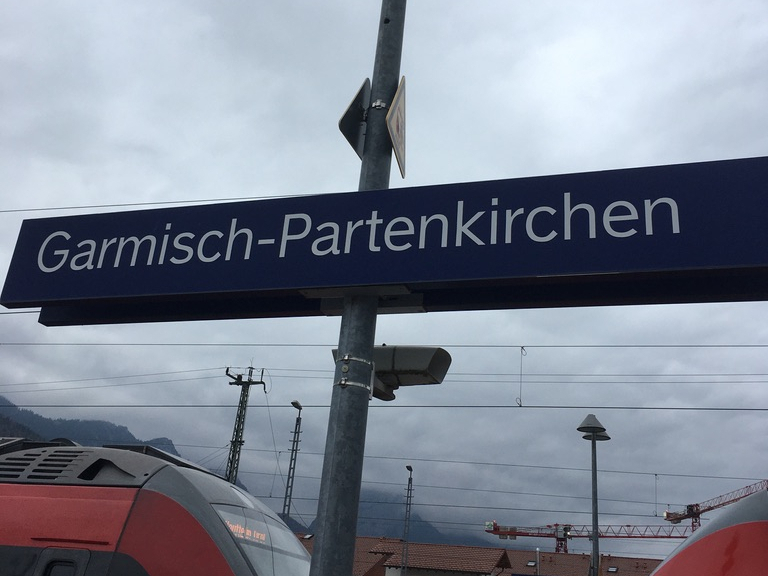
On April 30, 1945, U.S. troops made their way up Richard Strauss’s driveway. A few months short of seventy-five years later, I did the same.

April 30, 2020 marks seventy-five years since one of the more curious episodes in music history. The familiar telling runs thus: While making its way through southern Germany in 1945, the advancing Allied army was in need of quartering, commandeering the larger houses and turning out their residents in the process. After entering the alpine town of Garmisch-Partenkirchen, a well-appointed villa was scouted at the end of Zoeppritzstraße, right at the foot of the Kramerspitz. Driving up to number 42, the unaware officers took part in a scene that could not have been written better. An octogenarian man—allegedly holding up documents ranging from pages of musical manuscripts to a proclamation granting him the freedom of Morgantown, West Virginia—greeted the detachment and announced himself in broken English as Richard Strauss, the composer of Salome and Der Rosenkavalier. The affable hospitality of the villa’s occupants, coupled with the musical chops of the soldiers, and their advancing orders, resulted in a valuable “off limits” sign posted at the gates of Zoeppritzstraße 42. The inhabitants were hardly left alone, however, as many musically-minded servicemembers came to meet Strauss, whose fröhliche Wertstatt was shortly to undergo a haggard relocation to Switzerland.


The incident at the composer’s front door was, however, a mere skit amid a sprawling European epic reaching its culmination. Only a few weeks prior, Strauss had finished the score of Metamorphosen, that manifold elegy for twenty-three strings, on April 12, 1945. In the intervening weeks, Germany’s downward spiral toward capitulation intensified. On April 25, British, Canadian, and American forces met those of Soviet Russia at the River Elbe in Torgau and Lorenzkirch. Nuremberg, one of the ideological hearts of National Socialism (and perhaps its greatest “theater”), fell on April 20. Just as Strauss was in the final stages of the Metamorphosen manuscript, the Allies made the first of many ghastly discoveries in Ohrdruf, the first liberated concentration camp, on April 4. A week later, the Fourth Armored Division and Eighty-Ninth Infantry Division of the U.S. Army freed the main camp at Buchenwald. The gates of Dachau’s hell were unshackled on April 29, just after Hitler and Eva Braun swore an eternal vow (to last barely twenty-four hours), and Benito Mussolini and Clara Petacci’s mortal remains were strung up at a gas station in Milan. Fearing a similar post-mortem spectacle, the Führer perished by his own hand on April 30, followed the next day by Joseph Goebbels.


7C925617-7175-400F-BF35-48830CFA92CD_1_105_c

View of the Zugspitze from 42 Zoeppritzstraße. Photo by the author.

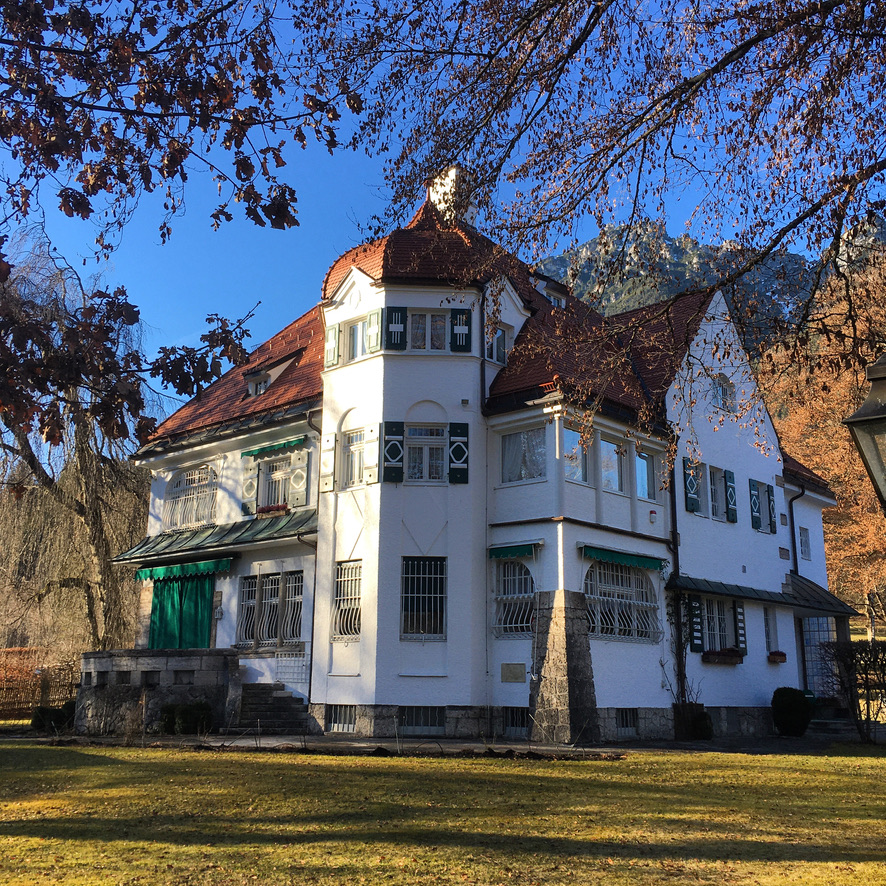
Under very different circumstances than 1945—but knowing full well the importance of the inhabitants—I made my own awkward American way to Zoeppritzstraße 42 for the first time on January 14 of this year, the first of three visits paid while undertaking dissertation research in Munich. I had been a regular visitor to the Richard Strauss Institut in Garmisch-Partenkirchen over the preceding months, but this was my first visit to the Strauss domicile itself. Still owned by the family, the edifice has not undergone conversion into a museum in its own right. While this might be lamented, I can only state that its interior aura—for lack of a better word—is that of potent reserve, a reserve that resists such public intrusion. One grasps at once how and why this location was such an important place for the composer. While the area is a skier’s paradise, winter was very much the wrong season to visit for Strauss. The composer constructed the villa with a view to its use in spring and summer, the bright months when he would devote his energies towards composition, generally reserving the more routine work of orchestration for the fall and winter amid his conducting engagements. I departed Europe in March because of the coronavirus crisis, and seeing Garmisch-Partenkirchen in full bloom, alas, must wait.

Balancing the villa’s calm is a curious sense of expectation. It still retains the spirit of a family dwelling, though it no longer functions as such in the day-to-day. While not a shrine, its walls still bear the curious collections of religious art Strauss and his wife purchased over their lifetimes, sharing space with the numerous hunting trophies of their son Franz. Maintained with reverence is Strauss’s study (Arbeitszimmer), where the calendars still read “September 8,” the date of his death in 1949. The room and its artifacts seem to await Strauss’s return, and what touched me most was something outwardly in need of repair: the desk blotter pad, which bears the wear marks left by Strauss’s left elbow as he worked.

But why? Why this? Why not the scores, piano, batons, even the death mask? I can only surmise that a seemingly insignificant example of use, an example of literal and figurative “wear and tear,” is significant because it lacks the heightened quality we normally ascribe to grander possessions. With these seeming blemishes, objects take on a different importance, one of purpose. Traces of use are truly human traces. They are what we all leave behind, no matter what the task.

B4DB7B1A-9523-44EE-8837-B1C17684BEC2_1_105_c

The villa at 42 Zoeppritzstraße. Photo by the author.

Upstairs in the villa is the former office of Strauss’s late daughter-in-law, Alice, to whom all Strauss researchers are and will remain indebted for her maintenance of the family archive. I had the formidable privilege of sitting at her desk to work through the composer’s voluminous correspondence with his theatrical collaborators. (Needless to say, her photograph kept me on task.) Across the hall is a more contemplative chamber, the room in which Strauss died. Here he had his famous last meeting with director Rudolf Hartmann on August 30, 1949, when he discussed future plans for his stage works. As Hartmann would later relate, Strauss wistfully recalled the plea of Wagner’s Isolde: “Greet the world for me” (“Grüss mir die Welt”). Within weeks, he was dead.


At the same time as the German collapse in 1945, Strauss was at work on a unique document. Known now as the “künstlerische Vermächtnis” or “Artistic Testament,” it was a plan for postwar operatic life drafted as a communique to Karl Böhm, music director of the Vienna State Opera, which by April of 1945 was a smoldering ruin. Entrusted to the hands of Alfred Mann, émigré, future musicologist, and Allied soldier moving through Garmisch, the essay was translated into English and handed over to the leadership of the American Third Army. It was later published in The Musical Quarterly in January 1950, just after Strauss’s death. (It would not appear in German until 1954.) It is one of several reflective works from the composer’s late period, conventionally seen as responses to the destruction of the theaters he held so dear. It is instructive, however, to see it, and many of Strauss’s similar efforts, as views forward rather than nostalgic glances backward. He takes the errors of the past into account and the prevailing devastation as an opportunity to maximize operatic life in the coming decades. The “Vermächtnis,” however, is far from a flattering document. In describing an ideal world of opera production based on national repertoire, Strauss fell prone to a problematic strain of cultural chauvinism, which was singled out by MQ editor Paul Henry Lang:

We print this interesting and pathetic letter for what it is—a document. It is interesting because it represents the views of one who has been the most significant German opera composer of the post-Wagnerian era; pathetic because while it contains some good ideas it shows that its author has outlived his own times and speaks from a vantage point that is no longer clearly perceptible to us. There is no need to point out historical inaccuracies, inconsistencies, and peculiarly Germanic theories, but there is something in the tone and substance of this manifesto of a bygone age that strikes a familiar ring. Our operatic life, as exemplified and oriented by the New York Metropolitan Opera House, shares that outmoded conception of opera with the composer of Salome. Those who are in charge of the Metropolitan’s destinies may derive some comfort from the undeniable authority of the recently departed famous musician, but it is hoped that they will also notice the passages that call for a more enlightened view, for new works and experiments.

Returning to Strauss’s essay, I was struck by echoes with our present situation in the time of coronavirus. Many comparisons have been made between the current crisis and the Second World War. With regards to the theaters and concert halls, however, the comparison is more than apt. Magnifying the state of affairs in 1945, cultural institutions not only in Europe but around the world remain shuttered on a scale not seen since, and we face difficult decisions about their revival and survival when mass events can take place again. The state of affairs is particularly dire moving into summer when all but a handful of the major seasonal festivals—opera, Shakespeare, or otherwise—have been canceled. The case in Bayreuth is addedly similar to 1945, when, in addition to there not being a festival, the hegemony of the Wagner family was all but forbidden. With Katharina Wagner’s resignation from the Festival leadership for health reasons, the enterprise hits a comparable crossroads. (The Strauss family faced their own difficulties amid the crisis. The ban on funerary events meant the cancellation of a March memorial service for Christian Strauss, the last living grandson of the composer, who passed in February.)

Unlike 1945, companies and venues around the world do not have to face the challenge of physical reconstruction. Or do they? The nature of the coronavirus questions not only of proximity, but of number. When circumstances again permit, how are mammoth auditoria to be used? Can they? Should they? Likewise, how are the smaller spaces to be used? How will the storefront theater experiences be changed? These familiar questions have no easy answers and I risk running maudlin by reiterating them here with no useful contribution. I believe, however, that they are far from endangered in the long run. My questions are predicated on a “when,” not an “if.” The live experience will not go extinct. We have seen a wealth of digital stopgaps bring performances into our homes over the past six weeks. But they are just that: stopgaps. The art-going experience is not contingent only upon “delivery” of an artistic “product,” or even the sense of “communality” in the experience, remote or in person. It is dependent on us leaving our personal realms and entering others, not strictly public or private, but different. Art takes place at these points of challenge and change, and they are always valuable. I write these present words from Austin, Texas, when it is unclear when a return to Garmisch for research is possible. I content myself, however, by catching the unconscious expression of hope in my own formulation.

When. Not if.