Thoughts on opera’s “child of woe” at 99.
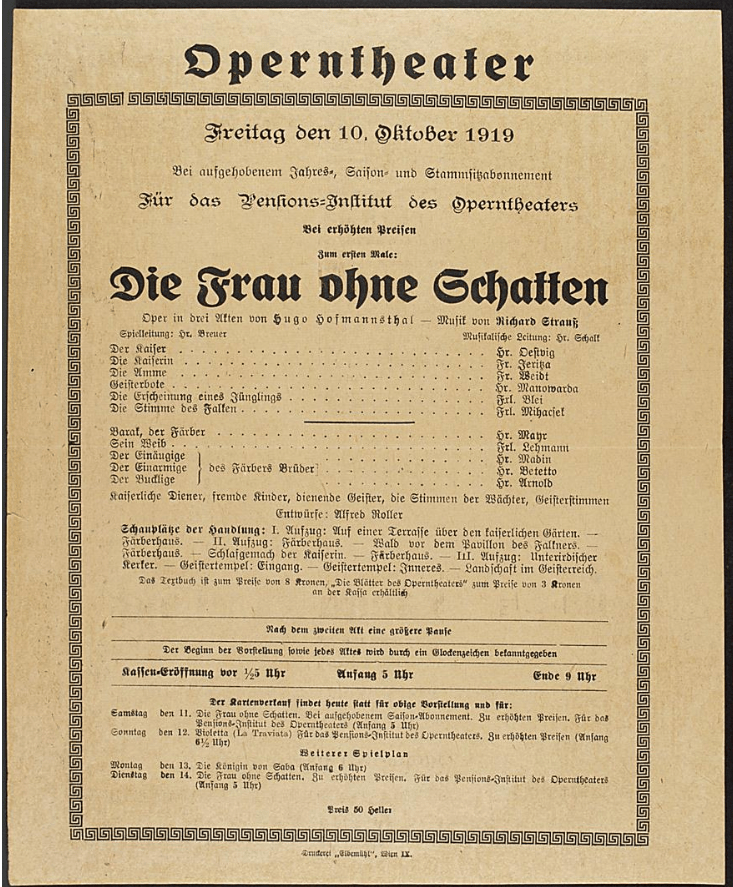
October boasts the anniversaries of more Strauss stage premieres than any other month of the year. Both versions of Ariadne auf Naxos (1912 and 1916) and the similarly rococo Capriccio (1942) all bowed within said interval. The one outlier among the group is the fantastical Die Frau ohne Schatten (1919). This year marks 99 turns of the sun since the caecilian “FROSCH” (as Strauss came to abbreviate it) made its inauspicious debut in war-torn Vienna at the newly christened Staatsoper. Amid many decades of reevaluation, this Erzählung has aged somewhat differently than the rest of Strauss’s oeuvre, particularly with its perceived endorsement of the subjection of women to roles of domesticity and the enforced bearing of children. Yet as Hugo Shirley’s research has shown, librettist Hugo von Hofmannsthal’s peculiar attempt at creating a Kunstmärchen, an artful fairy tale, replicates a number of tropes present in Gozzi, Goldoni, Goethe, the Brothers Grimm, as well as a host of other sources. Such a goal and heritage offers a partial explanation for its allegorical emphasis on conditions of conception and fertility.
Continue reading “Three Fragments on Die Frau ohne Schatten”
 Can You Not Hear It?