“Régi vár, régi már…”
Old is the castle, old is the tale…
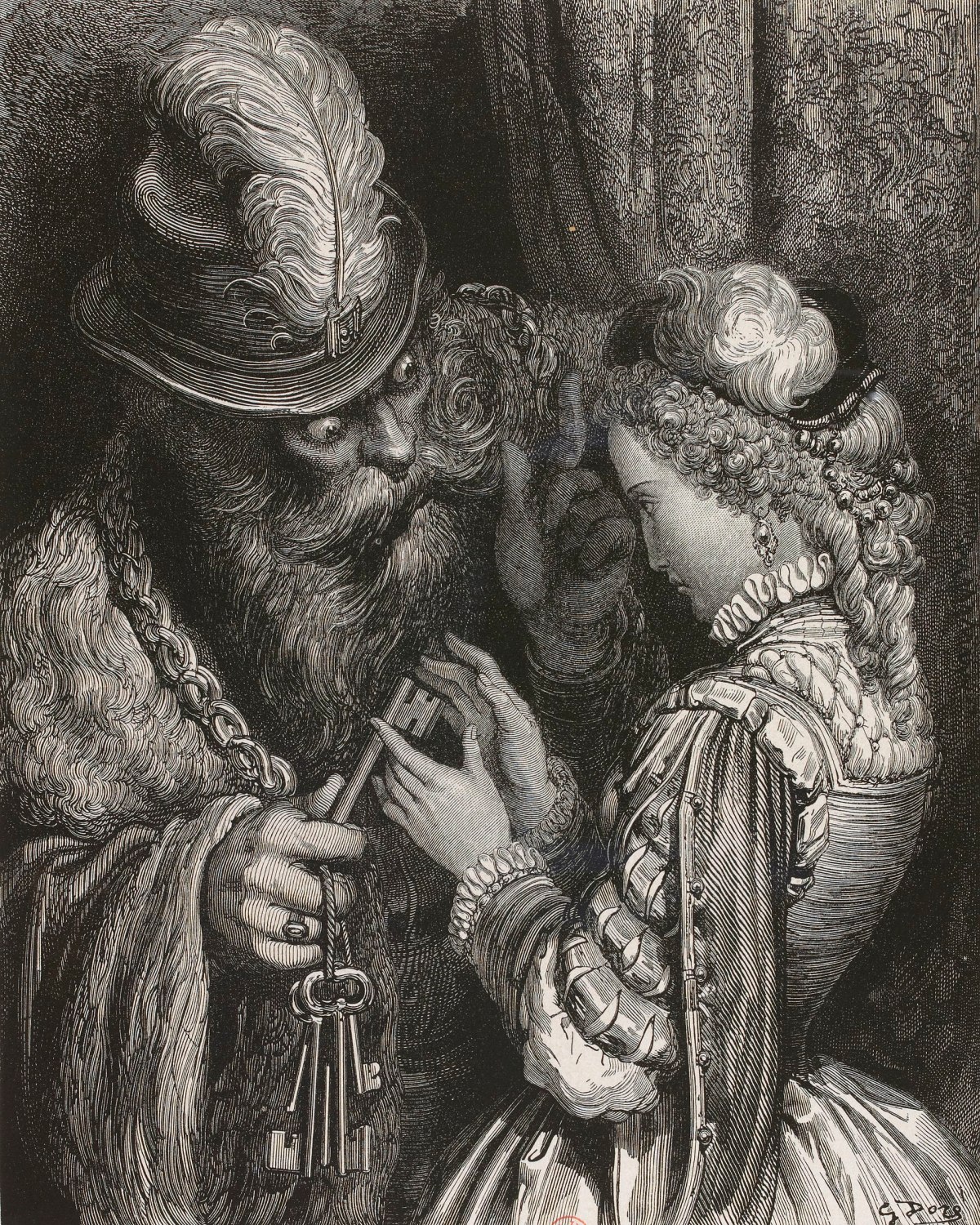
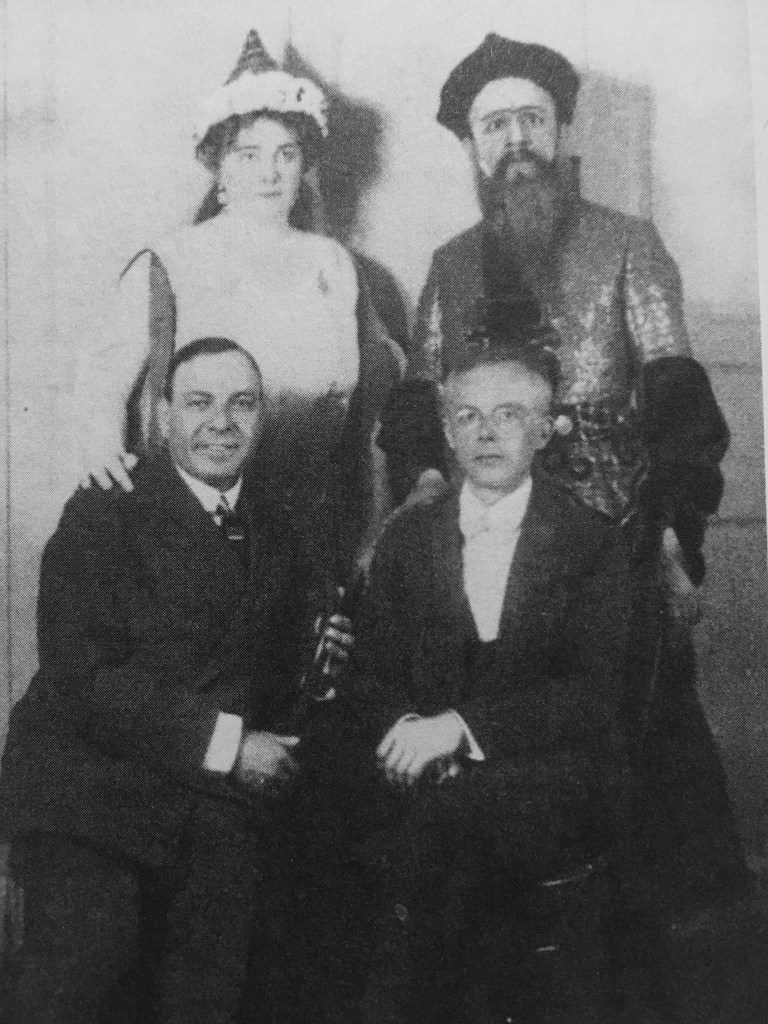
Béla Bartók’s A Kékszakállú herceg vára, The Castle of the Blue-Bearded Duke but known to us in English as Bluebeard’s Castle, premiered at the Hungarian Royal Opera House on May 24, 1918, on a double bill with his ballet The Wooden Prince (A fából faragott királyfi). Almost seven years had elapsed since Bartók completed the full score on September 20, 1911. This one-act would remain his only completed vocal work for the dramatic stage, but there are whole catalogs of other operas that can only aspire to its achievement in composition and orchestration. As always in Bartók, every harmony, every gestural effect is the result of careful calculation that appears effortless. Taking multiple cues from Perrault as well as Maeterlinck, the libretto by Béla Balázs, also the author of the scenario for The Wooden Prince, is equally a masterpiece. Like Pelléas and Tristan, Bluebeard’s Castle is a symbolist work of psychological experience with little overt stage action, at least as originally conceived. Modern stagings take their own points of departure, as will be seen.
This is undoubtedly the strangest of marriage operas, a distinction already bizarre in its own right. Its action, however, can be summarized in one sentence: Bluebeard brings his new wife Judit (Judith) home to his castle, she begs for the keys to the seven doors of his great hall, and she opens them. Yet between all those keys and doors, whole worlds are conjured and vanish as we get ever closer to the final, deadly secret of Bluebeard. But is it really his secret? The title, even in English translation, emphasizes a specific dramatic symbol. The opera is entitled not “Bluebeard,” not “Judit,” not “Bluebeard and Judit,” but “Bluebeard’s castle.” Many have interpreted the castle as a manifestation of Bluebeard’s soul, not least from the evocative statements of Judit that the walls are “sweating” and then “weeping.”
The boundaries between character and structure are nebulous throughout. Each doorway that Judit opens unleashes a synesthetic lighting effect illustrative of what lies beyond: first, for the torture chamber, light that is blood red, falling in a rectangle on the floor “like an open wound” (44); second, for Bluebeard’s armory, a “yellowish red” light, “at the same time dark and frightening” (65); for the treasury behind the Third Door, a “brilliant gold” light (78); and out o the Fourth Door comes the “bluish-green” light of Bluebeard’s garden (90).[1] The original stage directions never state that Judit disappears from sight when entering these rooms, nor that the rooms beyond be shown in their abstract or literal entirety. For the treasury, however, Balázs stipulates that Judit rummage through the riches to select jewels, a crown, and a mantle, and lay them on the threshold, choices with great significance for the end of the opera. The stage directions also note that branches of flowers come forth from the Fourth Door when it is opened.
The Fifth Door is probably my favorite moment in the entire work. Here the lighting and musical effects hit their extreme, but this is not yet the climax of the opera. In a work latent with problematic questions of agency, power, and sexual metaphor, I realize calling this moment orgasmic is wide of the mark but nonetheless crucial for interpretation. The descriptions of what lies behind the previous doors are packed with sexual imagery, such as the phallic instruments in the torture chamber and armory. As she stares within, Judith is disturbed by the presence of blood on the objects, the most vivid being the description of the flowers in Bluebeard’s garden growing in blood-stained soil. According to the original stage directions, the Fifth Door is the first that Judit opens with violent suddenness. Here the symbolist fantasy of the work increases. The door reveals no chamber, but instead there is a “high veranda” and “distant landscape,” accompanied by a “brilliant flood” of light, presumably in a natural and unfiltered torrent. Bartók brings forth the orchestra’s full majesty at this point in the score, boosted by organ and offstage brass, in a surging chorale with Judit letting forth an “Ah!” on a high C that leaves little to the imagination (116).
In the ebb after this tidal wave, Bluebeard asks Judith, parlando, “See, the vastness of my kingdom, reaching past the far horizon. Is it not a splendid sight?” (121) After another C major crescendo, Bartók cuts the orchestra off. In chilling silence, Judit absent-mindedly agrees that “vast and boundless is your kingdom.” The chorale returns, and Bluebeard once again compliments the beauty of his domain. The current is broken once again as Judit responds in stark silence, “Vast and boundless is your kingdom.” If the entire opera is rife with coital subtext, then this is undoubtedly the strongest instance of coitus interruptus.
If I have one complaint against staged Bluebeards, it is that the opening of the Fifth Door is never impressive enough to match the music, clearly Bartók’s answer to Strauss’s Also sprach Zarathustra. Boulez’s two recordings are essential listening, but do yourself a favor today and listen to either Tatiana Troyanos or Jessye Norman sing that threshold into the next century.
Beyond lighting, Balázs and Bartók are highly specific about sound effects. The noises of unlocking and opening the doors are given exact descriptions in the text, as are the jingling and clanking of keys, the operative and most sexual prop of the entire work. It is also the only opera in which a structure vocalizes in its own right, another sign of its sentience. Balázs’s stage directions note: “The sound is answered by a cavernous sighing, as when the night wind sighs down endless, gloomy labyrinths.” The secrets of those sighs become more apparent at the Sixth Door. Emboldened and animated by the Fifth Door, Bluebeard asks Judit to embrace him, but she refuses. There are two more doors left unopened, and she shall not be denied: “I do not wish that there should be any more doors closed before me!” Her power in the interaction begins to surpass Bluebeard’s. She demands the key and gets it. When she turns it in the latch, however, the sound that follows is new—“a deep sobbing sigh” from which she recoils. Despite Bluebeard’s plea, she opens it in silence. There is no additive light effect here, only a reductive one: “The hall becomes noticeably darker, as though a shadow has passed over” (139). Behind the door lies a pond of Bluebeard’s tears, silvery white.
Now Bluebeard asks for a kiss, which Judit at first resists but then gives twice. There is still one more door, and she makes the most dangerous request of the opera: “Tell me whom you loved before me?” (162). His refusal to answer brings Judit to a pitch of anger. She knows full well what is behind the seventh door, what has been rumored, and what has been gnawing at her mind the whole time: “That is where your former wives are, murdered, frozen in their own blood” (175). His defenses shattered, Bluebeard offers the final key, which for a moment Judith resists. When she does take it and unlock the last portal, the Fifth and Sixth Doors close with “a gentle sigh” and the hall becomes darker (183).
“Silvery” moonlight pours forth from the doorway, and movement comes from the other side for the first time as Bluebeard’s three previous wives emerge in royal raiment. First is the one met at dawn, the next the one met at midday, and the third the one met at sunset. Each has increased his power, and before them, Bluebeard claims himself to be a mere beggar (192). The wives leave through the Seventh Door as he apostrophizes them. Judit, the wife found at midnight, the source of the moonlight, completes their number. The door to the garden closes. Now Bluebeard takes up the baubles Judit pulled out of the treasury and places them on her person, first mantle, then crown, then jewels. Now the Third Door closes. Bluebeard acclaims Judit as the fairest of all four. She exits through the Seventh door, which closes behind her. The hall now darkens entirely, consuming the solitary Bluebeard and reigning forever. The tale is told.
Bluebeard’s Castle was one of the last operas I was able to see at the Bayerische Staatsoper in Munich, on a double bill with the composer’s Concerto for Orchestra. This was the opera’s debut at the Nationaltheater, the first company performance taking place in 1955 during its years at the Prinzregententheater. Neither work is easy on its own, and the Bayerisches Staatsorchester and conductor Oksana Lyniv were the undisputed heroes of the evening.
This was also my second Katie Mitchell production of the 2019/2020 season, after seeing her adaptation of Virginia Woolf’s Orlando at the Schaubühne in Berlin in September. Mitchell is probably the most effective of cinematically-minded stage directors active today. That statement is not meant to be either dismissive or denigrative, just the opposite in fact. For all the mediating layers, the sense of liveness in never lost in her work. The Orlando in Berlin, for example, was akin to watching a live teleplay in the studio. The lower level of the stage was a warren of pull-away walls and props. Rapidly reconfigured amid costume and makeup changes, the action moved from Elizabethan England to the present as live sequences filmed by cast and crew alternated with sequences pre-shot on location. Overriding all this tumult was the calm voice of the narrator housed in a booth on the second level next to the projection screen.
The Munich double-bill featured a more expansive world, embracing a dynamic realism different from the static symbolism of the original scenario. Entitled Judith, Mitchell and her collaborators envisioned the Bluebeard narrative as a crime story, taking many cues from the British television series Prime Suspect (Dame Helen Mirren’s Jane Tennison graces the cover the program book), the Law and Order franchise, and the redoubtable cinematic standard The Silence of the Lambs. The first half of the evening is an elaborate film prologue played with the Concerto for Orchestra as accompaniment. The abduction of three female escorts in London by the mysteriously wealthy Bluebeard (John Lundgren) is montaged against the storyline of detective Anne Barlow (the always intense Nina Stemme) piecing the clues together. The abduction sequences depict Bluebeard working through a disillusioned chauffeur intermediary who picks up the women in London. He has them don blonde bob wigs before offering them a laced bottle of mineral water. Once unconscious, he leaves them at his boss’s mercy in a cavernous garage. Once incapacitated, they are bound by Bluebeard and imprisoned in a basement cell. All three victims were linked to a website offering connections with mature women, and their profile pictures all featured a necklace with a cross. To hunt down the abductor and free the women, Barlow goes undercover as an escort complete with wiretapping equipment. By the end of the Concerto and film, she is in Bluebeard’s domain.
The choice of the Concert for Orchestra as accompaniment for the film was more effective for the first three of its movements, where mystery and menace are more prevalent. The titles of the second movement, “Presentando le coppie” (Presentation of the Couples) or “Giuoco delle coppie” (Games of the Couples) depending on the iteration of the manuscript, took on added significance in the new context. The more burlesque tone of the fourth movement, however, and the jocose fugues of the fifth seemed incongruent with the seriousness of the film, though the energetic conclusion of the fifth movement did make for an effective segue into the opera proper, without pause. This link unfortunately meant the excision of Balázs’s highly theatrical spoken-word prologue to the opera, undeniably a difficult element to reconcile with the “true crime” atmosphere.
At this point, the film screen was flown out to reveal a stage set approximation of Bluebeard’s garage. Barlow’s escort character “Pippa” goads Bluebeard on via role play to reveal all his secrets. As with Treliński’s recent production of Bluebeard at the Metropolitan Opera, one which took a Fifty Shades of Grey and American Psycho premise as a framing device, the stage action depicts a journey through sequential chambers of Bluebeard’s domain. All the libretto’s door/color symbolism is dispensed with as the rooms become literal equivalents of the chambers described but not fully seen in the original libretto. The Fifth Door, for example, becomes a virtual reality playroom that Bluebeard shows Judit with an elaborate setup. It is not long before he realizes the deception, however, but be plays along and corners Barlow in the penultimate chamber. She eventually disarms him and frees his captives but comes close to losing her own resolve at the end. This brings on a different kind of darkness, one which the characters and even the audience have a tough time escaping.
[1] Numbers in parenthesis refer to pages in the 2007 study score edited by Bartók’s son Peter Bartók.

 Can You Not Hear It?